
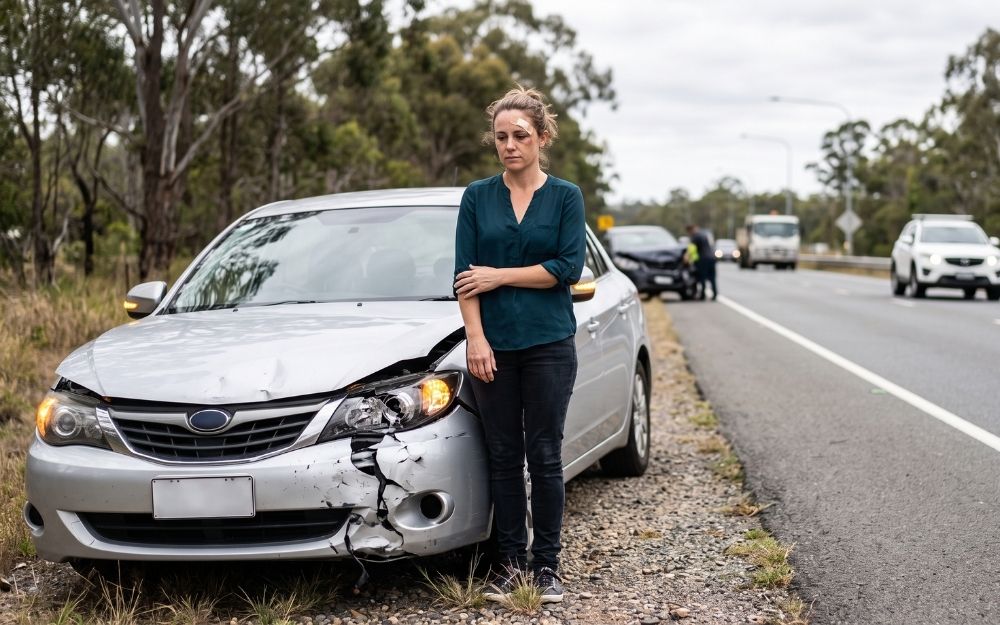
In late April 2026, Queensland Police launched Operation Interpose — a year-round road policing operation designed to close the gaps between the state’s four seasonal road safety campaigns. It was not launched because things were going well. Queensland’s road toll has climbed materially since 2019, and by late April 2026 the state had already lost 98 lives on its roads that year. If you or someone you love is one of the people behind those numbers, statistics are not much comfort. What follows is the practical part: what the figures actually say, and what to do in the days and weeks after a crash.
What the numbers show
The comparison that prompted the operation is stark. Queensland recorded 220 road deaths in 2019 — a record low at the time. In 2024 the figure was 301, and in 2025 it was 306. By the end of April 2026, 98 people had died on Queensland roads.
Running alongside that is an enforcement story. Police road safety enforcement hours fell sharply after 2019, dropping roughly 46 per cent by 2024 before beginning to recover in 2025. Operation Interpose is the response: high-visibility patrols, random breath testing and speed detection maintained through the whole calendar year rather than concentrated around the holiday periods.
Two points are worth holding onto. First, fatalities are the visible edge of a much larger number of serious injuries — people who survive and then live with the consequences for years. Second, more enforcement across the year means more crashes are formally recorded, investigated and attended. For injured people, that is quietly useful: an official record made at the scene is far better evidence than a memory reconstructed six months later.
It is also worth being honest about what the road toll leaves out. For every death, there are many more people who walk away from a crash and then spend the next two years managing pain, sleep problems, reduced work capacity or an anxiety about driving that will not lift. Those outcomes do not appear in a weekly figure, but they are the ones our clients are living with.
The first hours: what actually matters
Nobody makes good decisions immediately after a crash. Adrenaline masks pain, and shock compresses time. A short mental checklist helps.
Make sure the crash is reported. Get the police event or reference number if police attend. If they do not attend, report it yourself where required. That number becomes the spine of your claim file.
Collect identification details. The registration number of the other vehicle is the single most important detail — in Queensland, a compulsory third party (CTP) claim is generally made against the CTP insurer of the vehicle that caused the accident, and the registration is what identifies that insurer. Names, licence details and contact numbers of drivers and witnesses matter too.
Photograph everything while it is still there. Vehicle positions, damage, skid marks, road conditions, signage, weather, lighting. Five minutes of photographs can settle an argument that would otherwise take months.
Be careful what you concede at the scene. Most people apologise instinctively after a collision — it is good manners, and it is also a statement that can be repeated back to you later. Be courteous, exchange details, cooperate fully with police, and describe what happened accurately. You are not required to reach a conclusion about fault while standing on the side of a road, and you are not in a position to, because you do not yet know what the other driver was doing.
Get checked, even if you feel fine. This is the one people skip, and it is the one that costs them most.
Why “I felt fine at the time” causes so much trouble
Soft tissue injuries, whiplash and concussion frequently do not present at their worst on day one. It is common to feel shaken but functional at the scene, and to wake up 48 hours later barely able to turn your head.
The problem is that the medical record does not know that. If your first medical contact is three weeks after the accident, that gap sits in your file permanently, and it invites a question you should never have had to answer: was this really caused by the crash?
Seeing a doctor early is not about building a case. It is about being examined by someone qualified while the injury is fresh, getting the right treatment started, and having an accurate contemporaneous record of what happened to your body. If you are experiencing neck pain, headaches or stiffness after a collision, our overview of whiplash and neck injury claims explains what these injuries commonly involve.
The same is true of the psychological side. Anxiety about driving, intrusive replays of the moment of impact, disrupted sleep, irritability — these are recognised injuries, not weakness, and they are far better addressed early than tolerated for a year.
Recovery and compensation are one story, not two
Most injured Queenslanders think of treatment and compensation as separate problems. Treatment is the doctor’s business; compensation is the lawyer’s business; and the injured person is left as the courier between them, forwarding reports and repeating their history to strangers while trying to heal.
Lifestyle Injury Lawyers was built to remove that job. Under the firm’s integrated model, assessment, treatment and compensation are coordinated by one unified health-legal team from day one, so that the care you need is arranged early and properly documented, and the claim is built from a complete picture rather than a reconstructed one.
That model carries an obligation, and it is worth stating plainly. Coordination never means influencing clinical judgement. Your treating practitioners exercise their own independent professional opinion, and your treatment is not conditional on running a claim — nor is your claim conditional on any particular course of treatment. Where a claim requires independent medico-legal opinion, that opinion comes from independent practitioners, not from a treating team.
It is not only drivers who can claim
A common and costly misunderstanding is that CTP compensation is something only drivers deal with. Queensland’s scheme is broader than that. Depending on the circumstances, a claim may be open to passengers, pedestrians, cyclists, motorcyclists, and people injured in vehicles they did not own or were not driving. Family members who suffer a recognised psychiatric injury in particular circumstances may also have rights.
The reason this matters is timing. People who do not think of themselves as “the person in the accident” tend to wait. A passenger assumes the driver is handling it. A cyclist clipped by a mirror assumes there is nothing to claim because the damage looks minor. A parent who arrived at the scene assumes their distress is simply part of being a parent. Months pass, and the same evidence problems appear that we described above.
If you were hurt in a Queensland motor accident in any capacity, the question of whether you have a claim is worth twenty minutes with someone who does this work — not months of guessing. Our Gold Coast car accident lawyers act for clients right across Queensland.
What a CTP claim looks like from the inside
A Queensland motor accident claim runs under the Motor Accident Insurance Act 1994 (Qld), overseen by the Motor Accident Insurance Commission. In broad terms it moves through four stages:
- Notification — a statutory notice of claim is given to the relevant CTP insurer.
- Liability — the insurer responds on whether it accepts responsibility, in whole or in part.
- Assessment — your injuries, treatment, work capacity and future needs are assessed, usually over months rather than weeks.
- Resolution — the claim is negotiated, most commonly at a compulsory conference, and settles or proceeds.
Each of those stages runs on time limits, and the periods that apply depend on your circumstances, the type of claim, and what you knew and when. The safe approach is the simple one: assume the clock started at the crash, and get advice early. Almost nobody regrets making the call too soon.
If you are worried the crash was partly your fault, that concern should not stop you making enquiries — Queensland law addresses shared responsibility by apportionment, as our article on claiming when you may have been to blame explains. And if you were a passenger on public transport rather than in a car, bus accident compensation follows similar principles.
Practical takeaways
- Report the crash and keep the reference number. It anchors everything that follows.
- Record the registration of the vehicle at fault. It identifies the CTP insurer you claim against.
- Get medical attention within days, not weeks — and go back if symptoms change.
- Treat psychological symptoms as real injuries, because they are.
- Keep a simple diary of pain, sleep, work capacity and what you have had to stop doing.
- Keep every receipt — treatment, travel, medication, help around the house.
- Do not settle while your treatment is still changing.
- Get advice early. Time limits are unforgiving in a way that injuries are not.
About Lifestyle Injury Lawyers
Lifestyle Injury Lawyers is a Gold Coast-based Queensland compensation firm with a straightforward view of what injured people need: your injury may be an event, but your recovery is a journey. Assessment, treatment and compensation operate as one unified health-legal team from day one, so recovery does not have to wait for paperwork. With more than ten years helping injured Queenslanders, offices in Southport and Fortitude Valley, and clients across Queensland, we act on a No Win, No Fee basis and offer a free Health and Compensation Claim Assessment. We are a proud sponsor of the Gold Coast Titans. One team. No Win, No Fee.
If you have been hurt on a Queensland road
You do not need to have all the answers before you make the call. Speak to Lifestyle Injury Lawyers on (07) 5627 0321 for a free Health and Compensation Claim Assessment, or contact us here. Focus on healing. We’ll take care of the rest.
This article is general information only and is not legal advice. Time limits apply to compensation claims in Queensland — speak to a lawyer about your circumstances.